Luck

Luck is standing in a line at high school orientation in front of the mom you had toured a different high school alongside. She recognizes you and introduces you to her daughter, who had been sick that tour day. You sit together and find each other again on the first day of school. You take classes together, spend weekends at each other’s houses, plan and save and ultimately go to Paris together with your moms.

Luck is going to a pre-high school party at a friend from summer camp’s house who brought together her friends from grade school and summer camp and meeting people that you then recognize on the first day of school. A group of friends coalesces that quickly loses the original dividing lines. You all have classes and eat lunch together. You hang out on the weekends and know each other’s parents. You don’t remember how you originally met. It’s lost in the general business of living and staying up late for book launch parties.

Luck is having a person you don’t know well because she’s been busy with soccer season point out that her student ID shortened her last name into her grade school nickname. From then on, you never call her anything else. She goes out of her way to have her dad drive you to a youth group. You go on ski retreats together where you are inseparable. You know the contours of each other’s lives. She becomes your college roommate.

It stops being luck somewhere along the way as you physically move away from each other and decide to stay connected. When you visit each other and plan a college graduation trip. When your group text spans a decade. When you’re in each other’s weddings. When you’re there for new babies and funerals.

They’re the ones you text at 7am because today you’re touring a middle school and how did we get here? Weren’t we in high school only a breath ago?

Twenty plus years of friendship. Lucky indeed.
Bites

I’m currently listening to Aimee Nezhukumatathil read Bite by Bite: Nourishments and Jamborees, her most recent book of essays. Each short reflection, poem, and memory is related to the foods – prepared, cut, or plucked – that have stuck with her mixed amongst botanical observations and moments of gardening and growing. It is a beautiful mashup of things I love – food, family, friendship, and ways of knowing – in lyrical reflection.

Her writing is top of mind tonight as I stand by the stove, mixing together a meal out of the bounty grown for me by my favorite farmers. We’ve reached the part of the year when I stretch to add vegetables to everything, at constant risk of getting behind the box that is refilled each Saturday.

Cutting orange-red tomatoes that finished ripening in a brown paper bag on the counter to the point of firm sweetness, arraying them on a small rimmed plate to chill before dinner, twisting salt onto each piece on my plate, watching my children attempt to cut through skins with their forks, dripping juice and smiling at their first tastes of summer. Remembering all the plates of sliced tomatoes on the too-small but somehow just right kitchen table at my parents’ house, where my knees knocked my brothers’ and we learned to chill and salt and savor from my dad, whose relationship with tomatoes is one that goes back to a youth’s worth of summers tending, suckering, harvesting, and eating. Who now cannot eat them without sneezing but still has a slice or two because they are summer.

Painting chairs

There are those traditions I pursue with, frankly, a touch of manic zeal. Celebrating Advent, making gravy for Italian Festival, putting up a Christmas tree with every ornament my kids have ever made. These are the traditions that I actively sought out. The ones from my childhood that I consciously intended to continue.

As my kids got old enough to remember year to year, they began to inform me about our family traditions as they saw them. We make a list of what we want to do during the summer and tape it to the wall. We tie dye tshirts. We have family movie nights.

I didn’t intend to start those traditions. They happened spontaneously, and the kids decided they were worth remembering, repeating, and adapting.

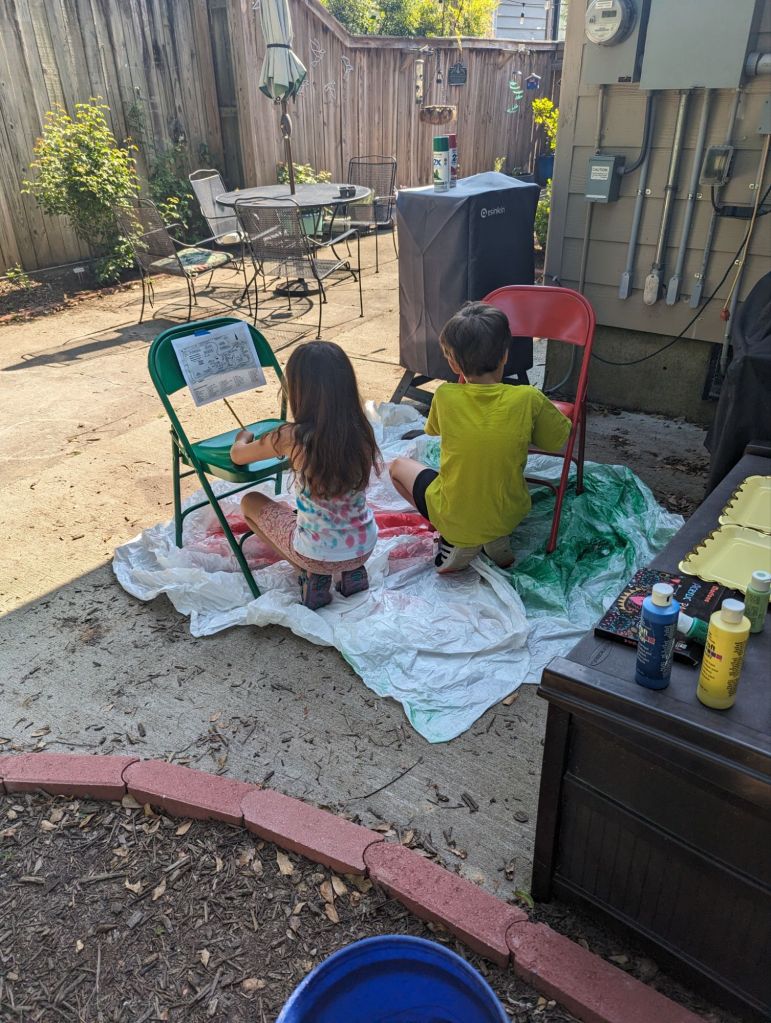
When I was in high school, I painted a set of beat up metal folding chairs with Italian phrases, outlines of Italian buildings, and names of my Italian Festival teammates (now hopelessly incomplete). Years later, my younger cousins added their own painted chairs to the collection. Today, my kids painted two more. My unofficial uncle (uncle by marriage? At this point, the lines are blurred enough that perhaps just uncle is most appropriate) mentioned some chairs that could use paint while we were putting up the fence around our booth. He brought them to my house, I did the spray paint, and my kids got to work. This afternoon, we’ll take them to the park and line them up with all the others.

Those original chairs are twenty years old. There was nothing traditional about them. Just something made by a kid who loved spending the first weekend of her summer with her family eating, sweating, and celebrating. How nice to see that be the tradition that is passing on.

Once a year

There are certain recipes I make once a year.

Each summer, I’ll get the fry oil to temperature, mix the cornmeal coating, set up stations, and fry a mess of green tomatoes. I’ll salt them while they drip oil, and we’ll eat them for dinner. We’ll eat so many that we won’t want them for another year. They are to enjoy and savour in the moment. To anticipate and remember as the year rolls along.

We’re seasons away from the next tomato frying, but it comes to mind on this windy, rainy, dark January evening because I’m preparing the opposite season’s annual culinary event. It’s French onion soup night.

Two days ago I thawed the beef bones that had been waiting in the freezer. Yesterday, those bones roasted for an hour with onions and carrots before being simmered for seven hours with peppercorns, garlic, celery, and bay leaves. Then came the cooling and skimming. The straining and pouring.

This afternoon, I sliced the ten cups of onions that are slowly caramelizing on the stovetop. In another half hour, I’ll add the garlic and thyme along with the stock and salt. While that simmers, I’ll grate cheese and make croutons. A mere 48-hours after I decided to make today onion soup day, dinner will be served.

It is deceptively simple. There is so very little to it except for time. Of course, I could cut out steps. I could buy the stock. I could accelerate the caramelizing. I could take back the time and still have soup.

But it wouldn’t be the same. It wouldn’t be the recipe we anticipate and savour and remember.

Circular

Every year I am compelled to write at the beginning of Advent. This year my favorite liturgical season is at its shortest – only 21 days between the first Sunday and Christmas Eve. Moving holidays have a tendency to sneak up on you. 

I’ve loved the long wait since we would light our very thin candles and say our call and response prayer when I was a child. We kept Jesus’s manger empty. We opened the doors on our paper calendar. We watched the big wreath at church get brighter. We waited. 

My current Advent wreath is one I made when I was three months married. We’ve changed out the candles over the years, but the bones remain the same. We’ve added nativity sets throughout our house, one of which has a star that we hide each day for the kids to find. All the mangers sit empty. The calendar’s drawers are filled with activities from the traditional – Christmas carol dance party, shopping for others, drinking hot chocolate by the fireplace – to the brand new – Cookies & Carols with the Memphis Symphony Orchestra. The days will get shorter, and we will wait. 

We will wait with anticipation for our Christ to be born again. The liturgical year is a cycle with no true beginning nor any real end. We wait, celebrate, repent, and celebrate in perpetuity. We can rest into the circular, giving our attention to where we are instead of where we are going next. 

Christmas will arrive, as it always does. But before it arrives, we will wait. We will wait as the lights on our wreath grow to replace the diminishing sun. We will wait as the world around us spins with frantic calls to spend our money and attention on the outward while we choose to look within. We will wait.

Clean

Start with the toilets. Hear the satisfying fizz of the vinegar hitting the baking soda; smell the clean tang of the tea tree oil. Move to the shower. Start scrubbing and realize that the tiles are not actually all the same color. Stomach the distaste and begin scrubbing. Realize that you need more help. Find the recipe for tile cleaner. Discover that there are no empty spray bottles. See that the wood cleaner is almost empty. Start deep cleaning the dining room furniture. Still a little left so move to the catchall drawers in the entryway. Find all the missing hats jammed behind the bottom drawer. Grumble. Remove them by squeezing your arm through the small aperture that appears when the drawer is mostly closed. Dispose of mismatched gloves and outgrown mittens. Find that there is somehow still wood cleaner and move to the end tables. 

Come to the realization that you are devoting the level of detail that you previously poured into work for other people into your home. Pause. Consider that you’re happy. Genuinely, unambiguously content. Smile. Write a couple of paragraphs. Remember that you still haven’t actually managed to clean the tile. 

Shrug. Decide to eat lunch first. And read while doing it. The shower will still be there. So will the satisfaction.

The best boy

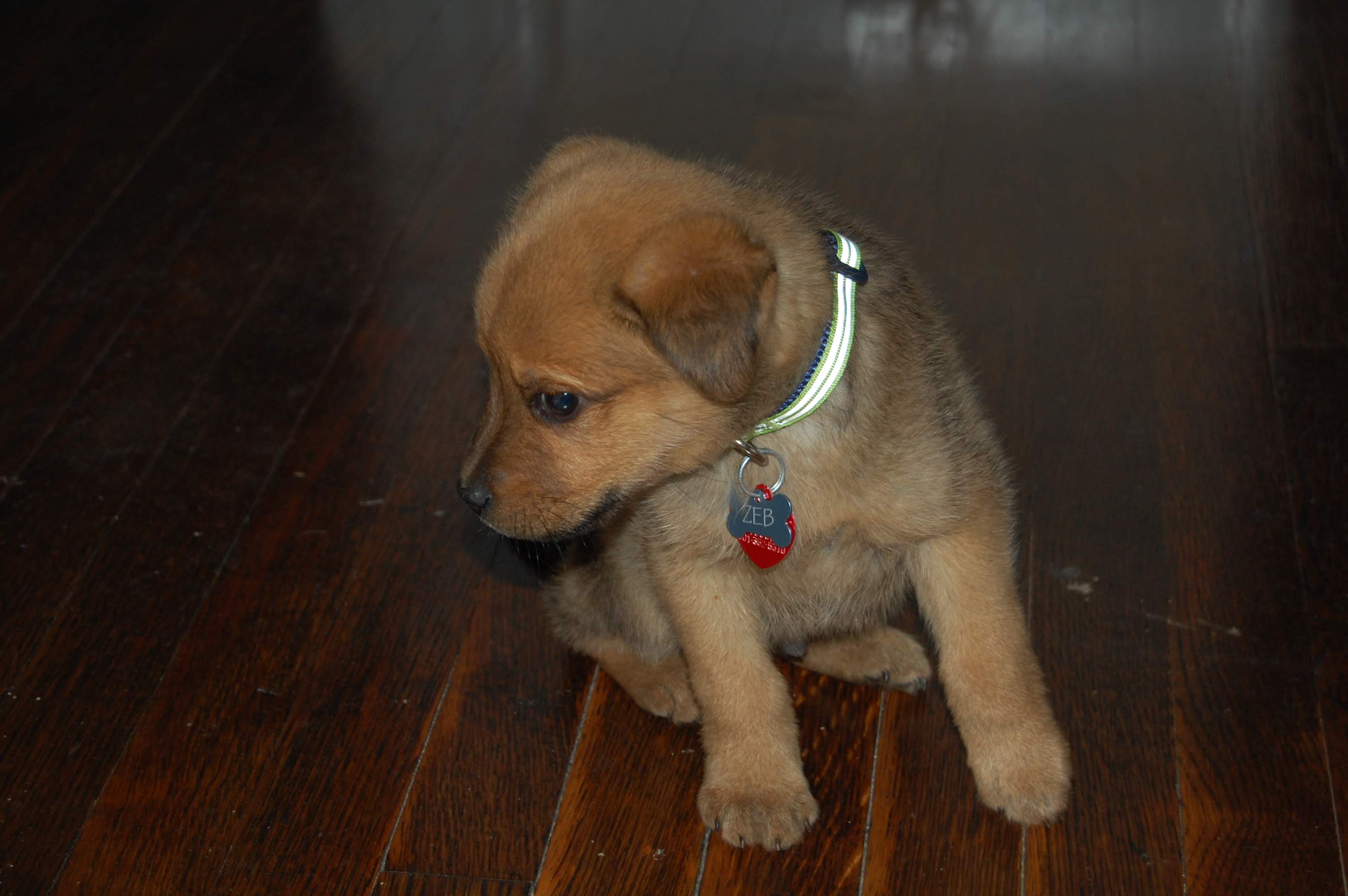
He was the smallest fluffball in the tiniest cage at Memphis Animal Services. Separated from the rest of his litter and curled into a small brown ball, there wasn’t anything terribly distinguishing about him. The worker helping us said he’d definitely be a mid-sized dog and perfect for an apartment, and we were naive and knew nothing about checking paw size, so we said that yes, we’d like to meet him. They brought us and the puppy to a small room where we could get acquainted. In those few minutes, he went from an anonymous mutt to Zeb. We didn’t meet any other dogs, and when we went to tell an employee, we couldn’t find anyone, so we took the opportunity to spend a few more minutes in the room with our new dog.

Greg brought him home from the pound a week later. Never had it been so hard to leave for class as when my puppy made his first explorations of our second-floor home. He loved to sit under the dining room chairs, contort himself into the fireplace, and conquer the mountain of blankets in the corner. He surpassed 35 pounds before his first birthday.

Zeb was never short for anything; it was the name I had always wanted to give a dog. The nicknames came later – Zebulon, Zebby Zeberton, Old Man. I accidentally trained him to go outside for the last time at night by singing “Outside, outside. Puppy going outside, outside.” He refused to go out at night without it, opting instead to stare at you before you gave him his cue. The first time he went outside in the rain when we moved to our house, he got “stuck” under the azaleas and looked at Greg like he was waiting for him to turn off the water. Greg carried his 95-pound butt inside.

When I was pregnant for the first time, Noah decided he was ready even if the rest of my body hadn’t received the memo. We headed to the doctor for my regular appointment, but my blood pressure had already started spiking. Zeb knew something was wrong with me before I did and for the first and only time, jumped in the car and refused to leave, moving from seat to seat until Greg eventually hauled him out. One medically induced labor and two days later, Zeb greeted Noah with the smallest of licks on the tip of the nose.

I do not want to say goodbye to him. Zeb was stinky and loud. He taught Rosie to howl at ambulances. He regularly ate monkey grass and dirt. He shed everywhere. He tolerated baby yanks, toddler tugs, and child hugs. He was my pillow and my friend. He gave me the weirdest ear kisses that felt like he was trying to take out my studs.

As Noah so eloquently put it, it is not accepting the days without him that is the hardest, it is saying the last goodbye. He was simply the best boy, and I will miss him.

Photo by Laurel Albrecht

Playing with words

Sometimes – when I’m walking or showering or folding the laundry – a phrase begins to rotate in my head. Subconsciously, words pull into an almost sentence and play three-card monte. Punctuation joins the party; commas insert themselves while periods delete. Verbs disappear to create powerful auditory punches. Ellipses and em dashes decide the pauses. When it pops into my awareness, I repeat it and play with it some more until I can write it down and use it to spin off a paragraph or two. Short essays, small thoughts, some alliterative fragments. It’s my favorite way to play.

Flu

I am excruciatingly bad at being sick. My brain cannot comprehend that my body can be felled by a microscopic virus turning pirouettes among my cells.

To be more accurate: I’m bad at being mildly ill. The under the weather when the symptoms are fatigue and chills but lack a fever or gastrointestinal distress.

I’m sternest with myself when I am this kind of sick. It’s the only way to get myself to stay in the chair drinking water and not “powering through” because it’s “not that bad.”

Get a flu shot. Mine is keeping me in mild discomfort and tired. Beats the pants off the alternatives.

Leap taking

Yesterday, I sent out my first four query letters to agents. It’s a scary concept, putting myself out there like that. Nobody likes rejection, and I am intentionally putting myself in the path of it. There’s no formula, no guarantees, no easy way out of this one. If I want this, which I do, I have to put myself out there, which I am.